Meltio Systems for Industrial Metal 3D Printing
Compare all Meltio metal 3D printing systems in detail: from the turnkey industrial printer Meltio M600 and the 8-axis Robot Cell to hybrid CNC and robotic integration.
Direct Technical Comparison of All Meltio Systems
Whether enclosed shop-floor printer, large-scale robotic cell or retrofit for existing machine tools – every Meltio system shares the same coaxial wire-laser core technology.
| System / Model | Architecture & Kinematics | Build Volume | Laser Source | Primary Application |
|---|---|---|---|---|
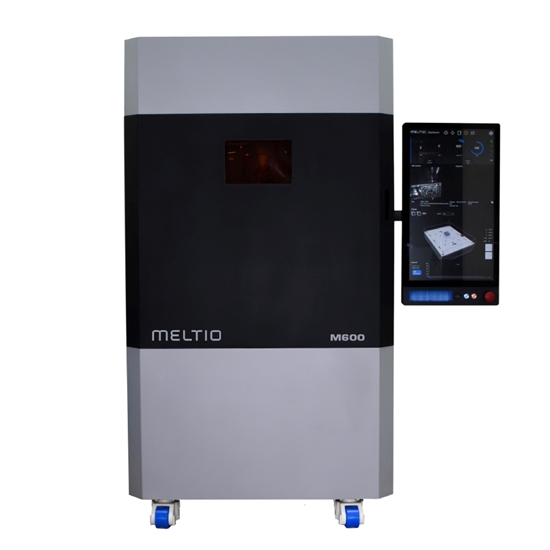
| Meltio M600 | Standalone 3-axis industrial printer (enclosed) | 300 × 400 × 600 mm | 1.000 W (9 × 450 nm) | Series parts, spare parts, functional components, dual-wire |
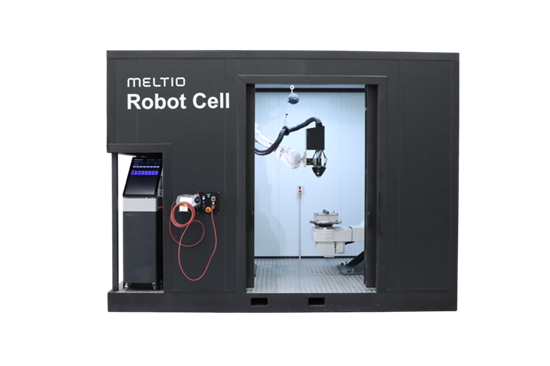
| Meltio Robot Cell | Class-1 laser cell: 6-axis ABB robot + 2-axis positioner | Ø 1.000 × 1.200 mm | 1.200 W (450 nm) | Complex large parts up to 500 kg, multi-axis support-free builds |
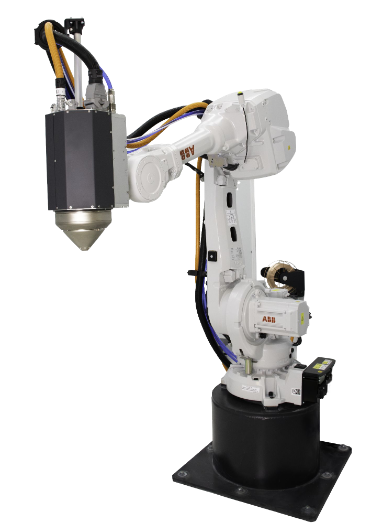
| Meltio Engine Robot Integration | Integration kit for industrial robots (ABB, KUKA, FANUC, Yaskawa) | Scalable via robot arm | 1.000 W (9 × 450 nm) | Large-format 3D printing, freeform cladding, part repair |
| Meltio Engine CNC Integration | Spindle-adjacent retrofit for vertical CNC machining centers | Defined by CNC travel | 1.000 W (9 × 450 nm) | Hybrid manufacturing: deposition + CNC milling in one setup |
Meltio Metal 3D Printers & Integration Systems in Detail
Meltio M600
The Meltio M600 is an industrial metal 3D printer for the precise production, repair and further development of metal components. The system works with wire laser technology: commercially available welding wire is melted by nine blue diode lasers and built up in layers to form a component. With a build envelope of 3…
Meltio Robot Cell
The Meltio Robot Cell is a compact, fully enclosed manufacturing cell for industrial metal 3D printing with wire and laser. It combines a 6-axis industrial robot with a 2-axis positioner, thereby enabling the additive manufacturing of complex metal components from different directions. With an installation space of …
Meltio Engine Robot Integration
The Meltio Engine Robot Integration expands an industrial robot into a flexible system for wire laser metal 3D printing. The compact, robot-guided print head works with nine blue diode lasers and processes standard welding wire with a diameter of 0.8 to 1.2 mm. In contrast to a closed standard system, the installati…
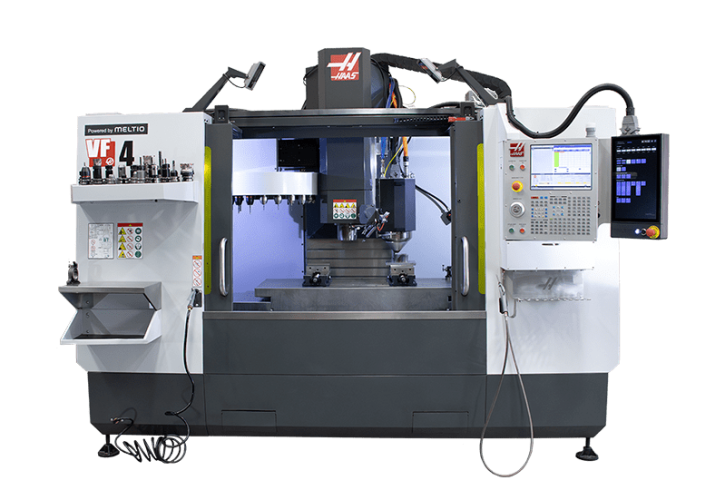
Meltio Engine CNC Integration
Meltio Engine CNC Integration adds industrial wire laser metal 3D printing to a CNC machining center. The print head mounted on the side of the spindle applies metal specifically to the component using welding wire and a blue laser. The CNC machine can then precisely mill or machine the component directly in the same c…
Why Manufacturers Choose Meltio Wire-Laser Systems
Unlike powder-bed metal 3D printers (PBF-LB/M), Meltio systems feed standard welding wire coaxially into an array of nine blue 450 nm direct diode lasers. The shorter blue wavelength is absorbed far more efficiently by stainless steels, titanium, nickel alloys and reflective copper alloys than conventional infrared lasers.
For machine shops and industrial plants, this translates into near-100% material utilization, zero explosive powder handling, significantly lower feedstock costs per kilogram and seamless integration into existing CNC or robotic workflows.
100% Wire Instead of Powder
Clean, safe operation in standard machine shops without respiratory or explosion-proof infrastructure required for loose metal powders.
Dual-Wire Multi-Metal
Dual wire feeders allow hardfacing wear layers, corrosion protection or functional material gradients on cost-effective base substrates.
High Part Density (> 99.9%)
Closed-loop laser and wire control ensures repeatable melt-pool stability and mechanical properties comparable to wrought or cast metal.
Repair & Near-Net-Shape
Build directly onto existing surfaces – ideal for tool and die repair, molds, shafts, flanges and casting replacement.
Evaluate a Meltio System or Discuss Your Application
Evaluating a Meltio M600, Robot Cell, or Engine integration for your shopfloor – or checking how your metal component performs with wire-laser deposition? Welding3D.de supports your system selection and brokers suitable systems directly via our platform.
Frequently Asked Questions About Meltio Systems
The Meltio portfolio covers four core system concepts: the standalone industrial metal 3D printer Meltio M600 (300 × 400 × 600 mm build volume), the turnkey 8-axis Meltio Robot Cell (up to Ø 1,000 × 1,200 mm), the Meltio Engine Robot Integration for industrial robotic arms (ABB, KUKA, FANUC, Yaskawa), and the Meltio Engine CNC Integration for hybrid CNC machining centers.
Meltio systems use wire-laser Directed Energy Deposition (DED-LB/M / W-LMD). Nine coaxially arranged blue direct diode lasers (450 nm wavelength, 1,000 to 1,200 W laser power) locally melt standard welding wire (0.8 to 1.2 mm) under shielding gas (argon or nitrogen), producing high-density metal components without hazardous loose powder handling.
Meltio systems process standard welding wires and specialty alloys including stainless steels (316L, 308L, 17-4PH), tool steels (H11, H13, M2), mild and low-alloy steels, titanium alloys (Ti6Al4V), nickel superalloys (Inconel 718, Inconel 625), as well as copper and selected aluminum alloys. Dual-wire capability allows combining two materials within one component.
The Meltio M600 is an enclosed turnkey shop-floor system with integrated XYZ probing, ideal for medium-sized production, spare and functional parts up to 300 × 400 × 600 mm. For large-scale parts or multi-axis freeform geometries, the Meltio Robot Cell or Engine Robot Integration is preferred. When additive deposition and precision milling in a single clamping setup are required, the Meltio Engine CNC Integration delivers maximum efficiency.
Welding3D.de helps companies evaluate the different Meltio configurations technically and brokers suitable systems directly via our platform. You can also submit feasibility inquiries for specific W-LMD metal components via Welding3D.de.