Meltio M600
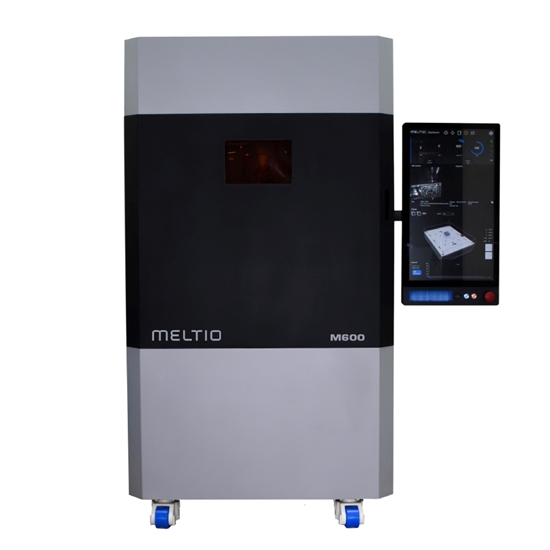
Enclosed production machine featuring 450 nm blue direct diodes, active inert chamber, automatic 3-axis calibration, and integrated Renishaw probing.
Meltio’s revolutionary Wire-Laser Metal Deposition (W-LMD) technology pairs standard welding wire with a patented coaxial multi-laser deposition head.
W-LMD stands for Wire-Laser Metal Deposition, categorized internationally under Directed Energy Deposition with Laser and Wire (DED-LB/M). Developed and patented by Meltio, it marks a breakthrough in industrial metal additive manufacturing.
Instead of costly, hazard-prone powder, Meltio uses standard certified welding wire (0.8 mm to 1.2 mm diameter). Fed coaxially through a patented multi-laser head, the wire is fully and cleanly melted into a localized inert gas melt pool, yielding dense, high-strength parts with 100% material efficiency.
Every gram of wire becomes part of the component – zero powder waste, no sieving, zero loss.
No airborne hazardous dusts, no ATEX explosion zoning, and no operator respirators required.
Fully compact microstructure delivering mechanical properties comparable to conventional wrought alloys.
Meltio’s technological edge centers on its proprietary deposition head architecture. Up to 9 independent direct diode laser beams are arranged in a circular array around the central wire feed.
Unlike off-axis wire systems, Meltio’s coaxial geometry delivers perfectly symmetric energy around the wire. Bead profile and metallurgical bond remain consistent across curves, sharp turns, and all travel vectors.
Systems such as the Meltio M600 feature blue direct diodes (450 nm wavelength) at 1,000–1,200 W. Energy absorption in highly reflective metals like copper and aluminum is up to 8x higher than with standard infrared lasers.
The head holds two independent wire spools concurrently. Operators can switch between two distinct alloys mid-print without downtime or tool changes – ideal for hardfacing onto ductile cores or functionally graded materials.
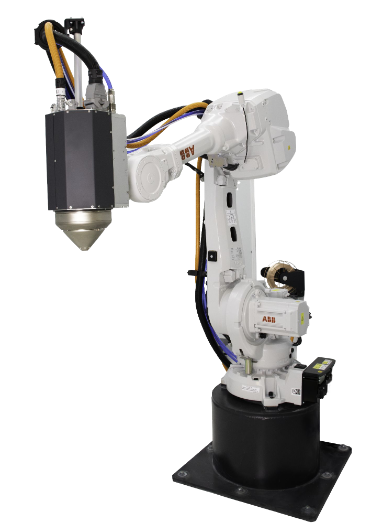
Unlike scanning galvo mirrors, Meltio directs collimated laser beams via solid-state optics straight to the focal point. This makes the deposition head exceptionally resistant to vibration and acceleration when mounted to CNC milling machines or robotic arms.
From standard industrial welding wire to a finished near-net-shape metal component: how Meltio builds layers.
A localized shielding gas envelope (high-purity argon or nitrogen) completely evacuates oxygen from the melt zone. The coaxially converging laser beams ignite, creating a tightly controlled micro-melt pool on the substrate or prior pass.
Welding wire is pushed smoothly through the center of the laser cone into the melt pool. The wire melts spatter-free, without droplet detachment or overspray, achieving 100% direct material deposition at the focal point.
Guided by CNC or robotic kinematics, the head follows CAM toolpaths. Rapid solidification produces a pore-free, fine-grained microstructure (>99.98% density), generating solid near-net-shape parts layer by layer.
Comparing wire-based LMD with powder-bed (PBF) or powder-blown DED systems reveals major economic and operational advantages.
Blown-powder DED systems waste 20% to 70% of powder overspray. With Meltio, every millimeter of fed wire is deposited directly into the melt pool with zero airborne loss.
Meltio uses standard commercial MIG/MAG welding wire spools. Wire is a globally standardized commodity with certified batch chemistry at a fraction of the price of gas-atomized powder.
Fine metal powders present serious inhalation hazards and explosive risks (ATEX). Meltio eliminates these liabilities entirely, allowing clean deployment in standard machine shops.
Compared with wire arc additive manufacturing (WAAM), focused laser energy provides a minimal heat-affected zone (HAZ), drastically lowering thermal distortion and residual stress.
Meltio spans the full spectrum of industrial manufacturing – from turnkey standalone 3D printers and 8-axis robotic cells to hybrid CNC machining center retrofits.
Enclosed production machine featuring 450 nm blue direct diodes, active inert chamber, automatic 3-axis calibration, and integrated Renishaw probing.
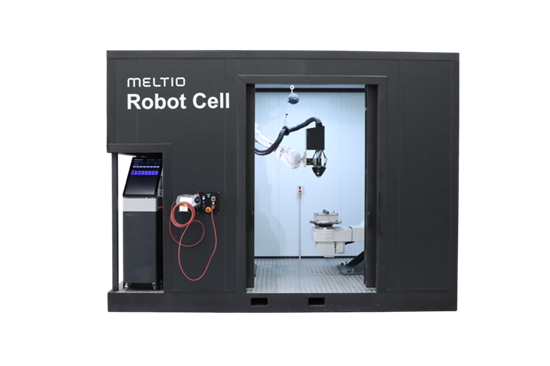
Turnkey 8-axis robotic cell (6-axis arm + 2-axis positioner) built for large components, complex freeform structures, and heavy repair jobs.
Retrofits existing industrial robotic arms from ABB, KUKA, FANUC, or Yaskawa into productive metal 3D printers with virtually unlimited build volume.
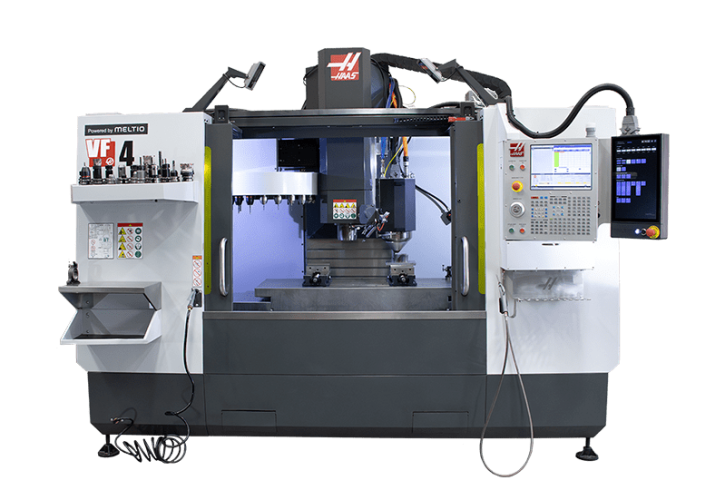
Transforms 3- or 5-axis CNC machining centers into hybrid systems: Additive deposition and subtractive milling to final tolerance in a single clamping.
Using standard welding wire opens up an extensive portfolio of certified, industry-proven metal alloys.
| Material Family | Specific Alloys | Key Properties | Typical Industrial Applications |
|---|---|---|---|
| Stainless Steels | 316L (1.4404), 308L, 17-4PH (1.4542) | High corrosion resistance, superior toughness, easy weldability | Chemical, food processing, marine, pump housings |
| Nickel Superalloys | Inconel 718 (2.4668), Inconel 625 (2.4856) | High-temperature strength, creep resistance up to 700°C | Aerospace, gas turbines, motorsport, exhaust systems |
| Titanium Alloys | Ti-6Al-4V Grade 5, Ti-6Al-4V Grade 23 (ELI) | Outstanding strength-to-weight ratio, biocompatible | Aerospace structural frames, defense, offshore, medical |
| Tool Steels | H11 (1.2343), H13 (1.2344) | High hot wear resistance, thermal shock stability | Die casting dies, forging dies, tooling repair |
| Copper Alloys | Reinkupfer, CuCrZr | Highest thermal & electrical conductivity (via 450 nm blue laser) | Heat exchangers, welding electrodes, induction coils, rocket nozzles |
| Aluminum Alloys | AlSi10Mg, AlSi12, ER4043 | Lightweight, good thermal conductivity, solid weldability | Automotive, prototyping, lightweight structural components |
| Mild & Carbon Steels | ER70S-6 (SG2), SG3 | Extremely economical, readily machinable, solid baseline strength | Heavy engineering, machine bases, near-net preforms |
Key process parameters and specifications of Meltio W-LMD technology at a glance.
Answers to key questions regarding technology, handling, and cost benefits.
Welding3D guides industrial companies through technology assessment, component feasibility checks, and targeted acquisition of Meltio wire-laser systems.