
Meltio M600 – Autonomous Industrial Metal 3D Printer
The Meltio M600 redefines medium-format metal fabrication: featuring 9 blue direct-diode lasers (450 nm), a sealed inert chamber, and integrated 3D touch-probing, the M600 produces production-grade parts directly from welding wire – cleanly, repeatably, and without hazardous powder handling.
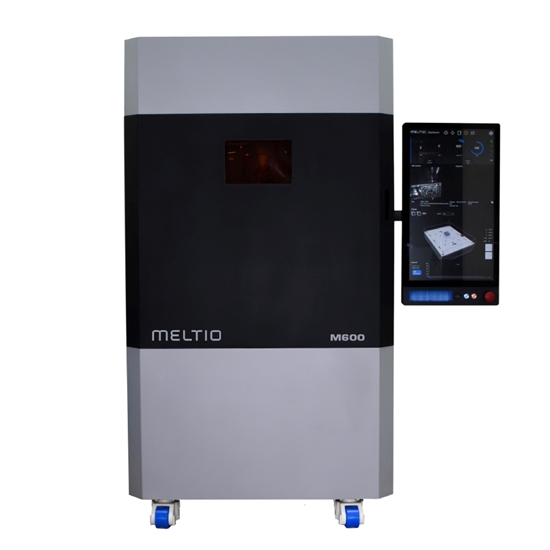
Engineered for 24/7 Factory Floors
The M600 closes the gap between slow powder-bed printers and complex robotic cells. As a standalone unit, it integrates seamlessly into existing CNC machine shops.
Blue Laser Technology (450 nm)
Nine coaxial blue diode lasers maximize energy absorption on copper (up to 8x) and aluminum, enabling robust deposition on highly reflective metals.
Sealed Inert Gas Chamber
Hermetically sealed chamber purged with argon or nitrogen, with active O2 monitoring (< 100 ppm) ensuring wrought properties on titanium and Inconel.
Autonomous 3D Probing & Inspection
Integrated 3-axis touch probe for automated workpiece alignment, zero-point finding, and layer height control – ideal for deposition on preformed casting/forging blanks.
100% Wire Material Efficiency
Every gram of wire melts directly into the weld pool. Zero powder waste, zero powder sieving, no ATEX hazmat requirements, and wire feedstock costs from 15 €/kg.
Robust 3-Axis Motion
Servo-driven linear axes with optical encoders achieve repeatability of ±0.02 mm, with optional rotary integration for axisymmetric parts.
Open Material Ecosystem
Use certified welding wires from any reputable alloy manufacturer without proprietary spool lock-ins, maximizing supply chain resilience.
Meltio M600 Technische Daten
300 × 400 × 600 mm
9 × Blaue Direktdiodenlaser (450 nm)
1.000 – 1.200 W
Ø 0,8 – 1,2 mm (Standard-Spulen)
300 kg Werkstückgewicht
bis zu 1,5 kg/h (werkstoffabhängig)
Argon / Stickstoff (Restsauerstoff < 100 ppm)
ca. 1.050 × 1.050 × 1.950 mm
ca. 950 kg
Verarbeitbare Legierungen
Der M600 deckt das gesamte Spektrum industrieller Schweißzusatzwerkstoffe ab. Die Materialeigenschaften nach dem Spannungsarmglühen entsprechen denen von Schmiedewerkstoffen:
- Edelstähle: 316L (1.4404), 308L (1.4316), 17-4PH (1.4542)
- Werkzeugstähle: 1.2709 (Maraging 300), H13 (1.2344)
- Nickelbasis-Superlegierungen: Inconel 718 (2.4668), Inconel 625 (2.4856)
- Titanlegierungen: Ti-6Al-4V Grade 5 & Grade 23 (ELI)
- Kupfer & Aluminium: CuCrZr, Reinkupfer, AlSi10Mg
Typische Anwendungsfelder
Durch die Kombination aus moderner Draht-Laser-Technologie und kompaktem Footprint etabliert sich der M600 branchenübergreifend:
Meltio Metall-3D-Drucksystem anfragen
Evaluating the Meltio M600 for your machine shop or checking component feasibility? Welding3D advises you as a specialized competence center and guides you through selection and implementation of the ideal Meltio machine.
Frequently Asked Questions About Meltio M600
What distinguishes the Meltio M600 from conventional metal 3D printers?
The Meltio M600 is engineered for lights-out 24/7 serial manufacturing on industrial shop floors. Utilizing cost-effective welding wire instead of hazardous powder ensures 100% material capture. Nine coaxial blue direct diode lasers (450 nm wavelength) provide dramatically higher absorption for reflective alloys such as copper and aluminum.
What build dimensions does the Meltio M600 support?
The usable build envelope is 300 × 400 × 600 mm (X × Y × Z). The build platform accommodates part weights up to 300 kg. Optionally, a rotary-tilt positioner can be integrated for 5-axis support-free deposition.
What shielding gas atmosphere does the M600 use?
The chamber is fully sealed and purged with argon or nitrogen. Built-in active oxygen sensing continuously keeps residual O2 levels below 100 ppm, safeguarding reactive alloys like titanium (Ti-6Al-4V) and Inconel from oxidation.
Which materials can be printed on the M600?
Thanks to the open material platform, the M600 processes standard welding wires conforming to DIN EN ISO standards, including stainless steels (316L, 17-4PH), tool steels (1.2709, H13), nickel superalloys (Inconel 718, 625), titanium (Ti-6Al-4V), copper alloys, and aluminum.