Wire-Based Processes (DED-LB/M, DED-Arc/M)
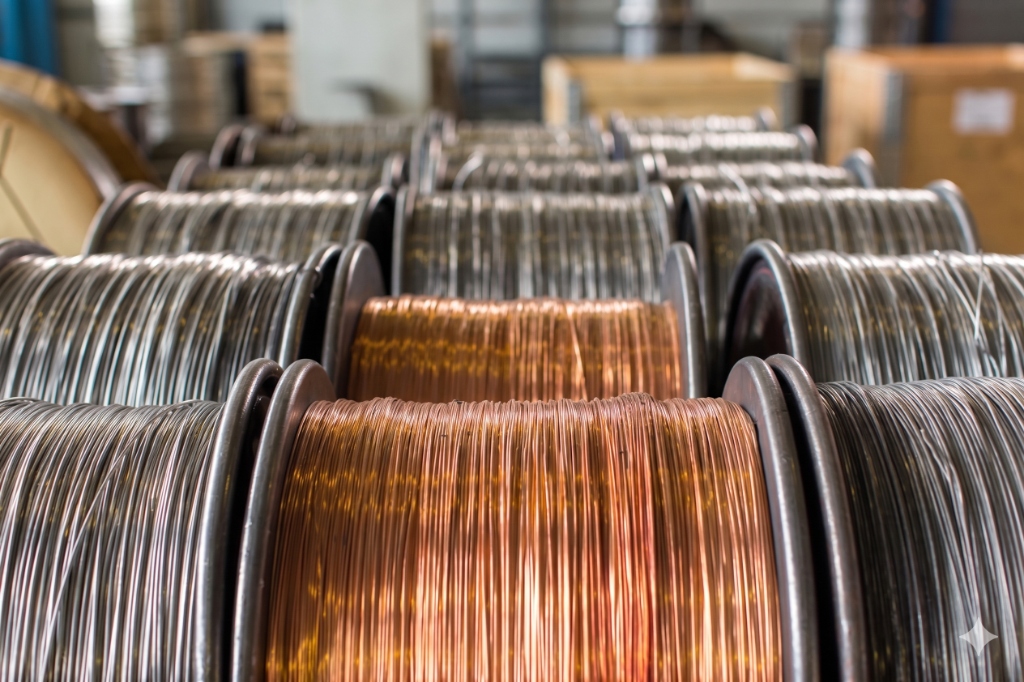
Metal wire as feedstock is non-explosive and not an inhalation hazard — safer handling than powder. High material utilization (>90 %), no powder recovery, more cost-effective raw materials.

Overview of common material classes for industrial metal 3D printing. The processability of a material depends, among other things, on the process (PBF-LB/M, DED-LB/M, DED-Arc/M), the system used, the process window and the component requirements. Not every material is available or suitable for every process.
The choice of feedstock (wire or powder) depends on the process and influences material costs, handling, process control and application areas. DED-LB/M and DED-Arc/M processes often use wire; PBF-LB/M processes work exclusively with powder.
Metal wire as feedstock is non-explosive and not an inhalation hazard — safer handling than powder. High material utilization (>90 %), no powder recovery, more cost-effective raw materials.
Metal powder in a powder bed enables highly complex geometries and fine structures. Unmelted powder can be partially recycled. Careful powder handling, storage and safety measures are required.
Not every material is available for every process. Material selection depends on the chosen process, the system, the process window, the component and subsequent post-processing.
The most widely used material family in metal additive manufacturing — excellent processability in DED-LB/M and DED-Arc/M processes, corrosion resistance, and a broad alloy selection for countless industrial applications.
Austenitic general-purpose stainless. Optimal corrosion resistance, biocompatible, universally applicable.
Welding filler alloy. Low carbon content prevents sensitisation, widely used.
Precipitation hardening steel. Very high strength after heat treatment (up to 1310 MPa Rp0.2).
Standard stainless. High ductility, good weldability, broad availability.
Ferritic stainless steel. Magnetic, good heat resistance, more cost-effective than austenite.
Duplex stainless steel. Combines high strength with corrosion resistance — especially against stress corrosion cracking.
Superalloys for extreme temperatures and corrosive media — indispensable in aerospace, energy and oil & gas.
Excellent corrosion resistance from cryogenic to 980 °C. High tensile strength, very good weldability.
High-strength nickel alloy for high-temperature applications up to 700 °C. Age-hardenable.
Oxidation resistant up to 1200 °C. Combination of high-temperature strength and oxidation resistance.
Nickel-base superalloy for gas turbine applications. Good creep resistance at high temperatures.
Excellent strength-to-weight ratio, biocompatible and corrosion resistant. Requires inert gas atmosphere during processing.
The most widely used titanium alloy. Two-phase α/β alloy with excellent mechanical properties and biocompatibility.
Commercially pure titanium. Excellent corrosion resistance, good formability and biocompatibility.
High-strength materials for toolmaking, mould construction and extreme wear applications. Ideal for repair and cladding.
Hot-work tool steel. Excellent hot strength and toughness, low distortion on heat treatment.
High-performance hot-work tool steel. Best hot wear resistance, for high-temperature tooling.
Pre-hardened mould steel. Ready to use without further hardening, good polishability.
Cobalt-base alloy with extreme wear resistance and corrosion resistance up to 900 °C.
Highest thermal and electrical conductivity for cooling components, heat exchangers and functional parts. The blue laser (450 nm) ensures optimal absorption for copper.
Precipitation-hardenable chromium zirconium copper alloy. High thermal conductivity + elevated strength. Ideal for rocket injectors and cooling channels.
NASA-developed copper alloy (Cu-8Cr-4Nb). Retains exceptional strength at elevated temperatures.
For the most demanding requirements: ultra-high-strength steels, special materials and new multi-material combinations.
Ultra-high-strength tool steel (≥ 1900 MPa). Low carbon, good weldability, extremely load-bearing after ageing treatment.
Nickel-iron alloy with near-zero thermal expansion coefficient. Indispensable for dimensionally stable structures.
Nickel-base superalloy for extreme operating temperatures up to 980 °C with high oxidation resistance.
Customer-specific wire materials and special alloys upon request — subject to system compatibility and process window.
Advanced materials for highly specialized niches such as medical technology, aerospace, and tooling.
Extremely wear-resistant and biocompatible. The absolute standard for dental implants and artificial joints.
High value, excellent conductivity and biocompatibility. Printed mostly via PBF-LB or Binder Jetting.
Superelasticity and shape memory effect. Extremely demanding in terms of process control (PBF-LB).
Extreme lightweight construction and resorbable medical implants. Highly reactive and flammable during processing.
Combination of extremely hard carbides and tough metal matrix. Predominantly processed via Binder Jetting.
No crystalline structure. Extremely hard, scratch-resistant and elastic. Very fast cooling rates required.
The specific material selection always depends on the chosen process (DED, LMD, Wire-Laser, WAAM), the system used, the available feedstock (wire or powder), the process window, the component geometry and subsequent post-processing. Not every material is equally available for every process and every system — a technical pre-assessment is recommended.