
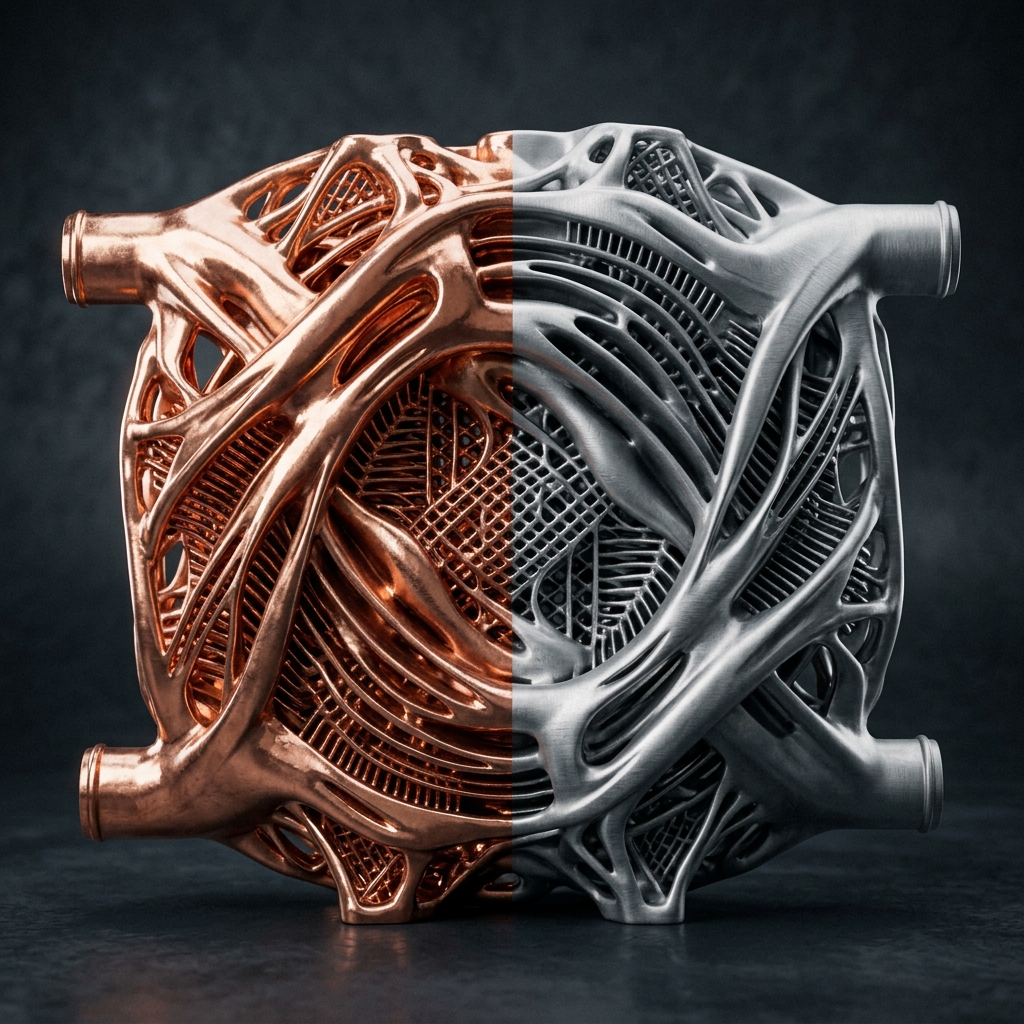
Copper: The King of Thermal Conductivity
The manufacture of compact, highly complex heat exchangers is one of the premier disciplines of metal 3D printing. Mathematically optimized lattice structures (like Triply Periodic Minimal Surfaces - TPMS, e.g., gyroids) maximize the surface area with minimal volume and pressure drop. But design is only half the battle—the choice of material dictates the final efficiency.
Historically, aluminum (AlSi10Mg) was the material of choice because it is exceptionally easy to print using infrared lasers (1064 nm). Aluminum offers a solid thermal conductivity of about 130 to 160 W/(m·K) after appropriate heat treatment and boasts a low specific weight, predestining it for aerospace applications.
The Breakthrough of Pure Copper in AM
Pure copper offers an outstanding thermal conductivity of approx. 390 to 400 W/(m·K)—more than double that of aluminum. The problem: pure copper reflects over 90% of the laser energy from standard infrared lasers and immediately conducts away whatever heat it does absorb. For a long time, maintaining a stable melt pool was nearly impossible.
Only the recent introduction of machines equipped with Green Lasers (515 nm) or Blue Lasers (450 nm) brought the breakthrough. At these wavelengths, copper absorbs laser energy extremely efficiently. This allows the printing of high-density pure copper heat exchangers that are thermally vastly superior to all other AM metals.
Aluminum or Copper—What to Choose?
- AlSi10Mg: The choice for applications where lightweight construction is the top priority (e.g., drones, aerospace) and thermal demands are moderate. Moreover, the printing process is much more established and cost-effective.
- Pure Copper / CuCr1Zr: Mandatory for high-end applications with extreme thermal loads, such as heat sinks for high-power electronics, CPU water blocks in server farms, or combustion chambers for rocket engines.
The trend is clearly moving toward specialized copper alloys. For those seeking maximum efficiency, copper printing with green or blue lasers is now the undisputed path forward.
No comments yet. Be the first to reply!