
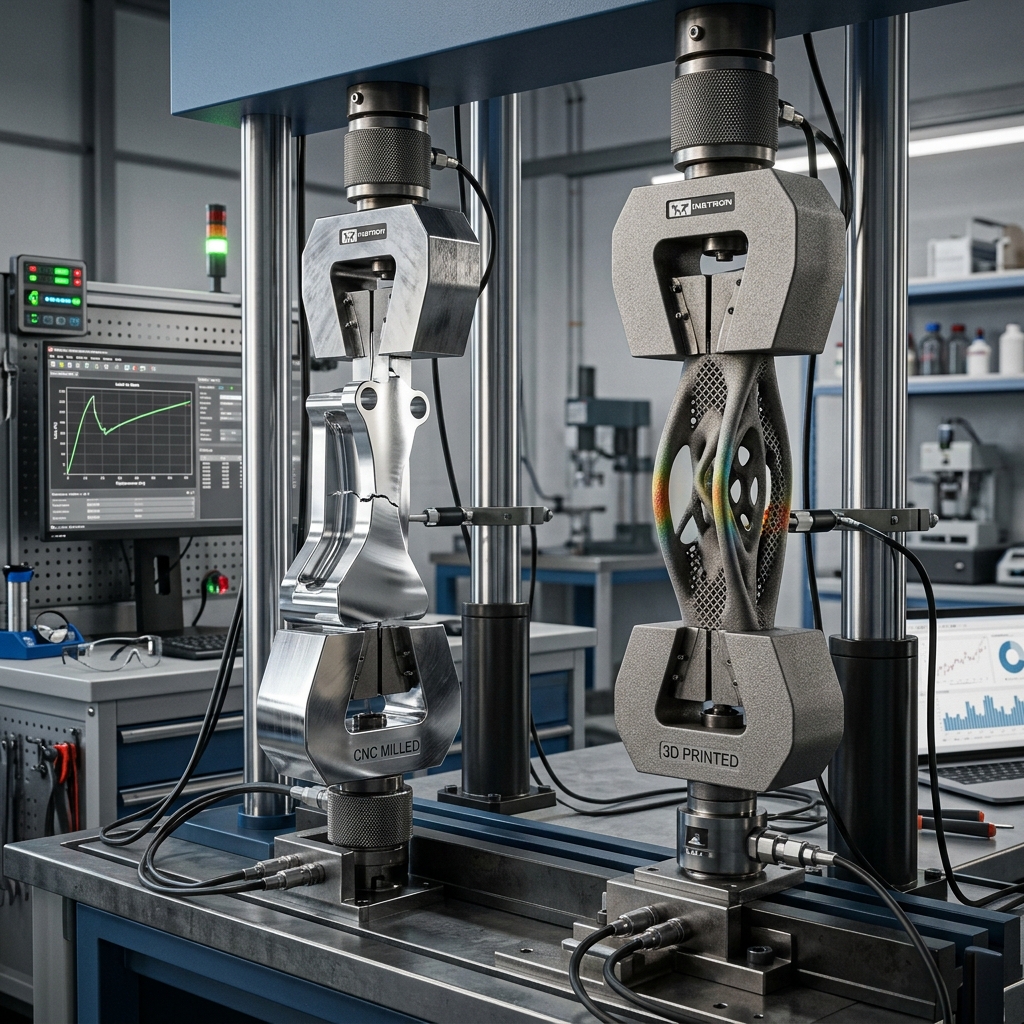
The Myth of Lower Fatigue Strength
When it comes to dynamically loaded components, for example in automotive or aerospace engineering, fatigue strength is the decisive metric. For a long time, the prejudice persisted that 3D-printed aluminum (especially the standard alloy AlSi10Mg) could never match the performance of CNC-milled components made from wrought alloys due to process-induced porosity.
Recent studies and industrial field tests, however, paint a much more nuanced picture. It is true: a PBF-LB/M printed AlSi10Mg part "as-built" (straight out of the printer, without post-processing) has a noticeably lower fatigue strength than a polished milled part. The cause lies in the microscopic notch effect of the rough part surface as well as in sub-surface defects (lack-of-fusion pores or gas inclusions), which act as crack initiators.
How 3D Printed Parts Reach the Level of Milled Parts
The mechanical properties of AM aluminum can be drastically increased through targeted post-processing steps:
- Hot Isostatic Pressing (HIP): By subjecting the parts to high pressure (often over 1000 bar) and high temperatures (approx. 500°C for aluminum), internal pores and voids are completely closed. Density increases to nearly 100%. HIP-treated AM parts often show S-N curves that are superior to castings and rival wrought alloys.
- Surface Machining: Since fatigue cracks almost always initiate at the surface, the "as-built" roughness (Ra often between 10 and 20 µm) is fatal. Tumble finishing, sandblasting, or ideally CNC milling of critical surfaces multiplies the component lifespan.
- Heat Treatment (T6): Solution annealing followed by quenching and artificial aging (T6 cycle) alters the fine microstructure of the AM aluminum and optimizes the ratio of tensile strength to elongation at break, which positively affects crack propagation speed.
Conclusion: An AlSi10Mg part printed according to state-of-the-art parameters, HIP-treated, and mechanically surfaced can achieve the fatigue strength of conventional parts while offering the unbeatable advantage of absolute design freedom (topology optimization).
No comments yet. Be the first to reply!