Why do 3D printed metal parts warp?
Residual stresses are the invisible enemy of every AM engineer. They arise from the extremely high thermal gradients during the Laser Powder Bed Fusion (PBF-LB/M) process. When the laser locally melts the metal powder, the melt pool expands. However, the immediately surrounding, already solidified and cooler layers restrict this expansion. As the melt then cools at a blistering pace (often with cooling rates of 10^4 to 10^6 K/s), it attempts to shrink but is prevented by the cold underlying material. The result: massive tensile stresses at the part surface.
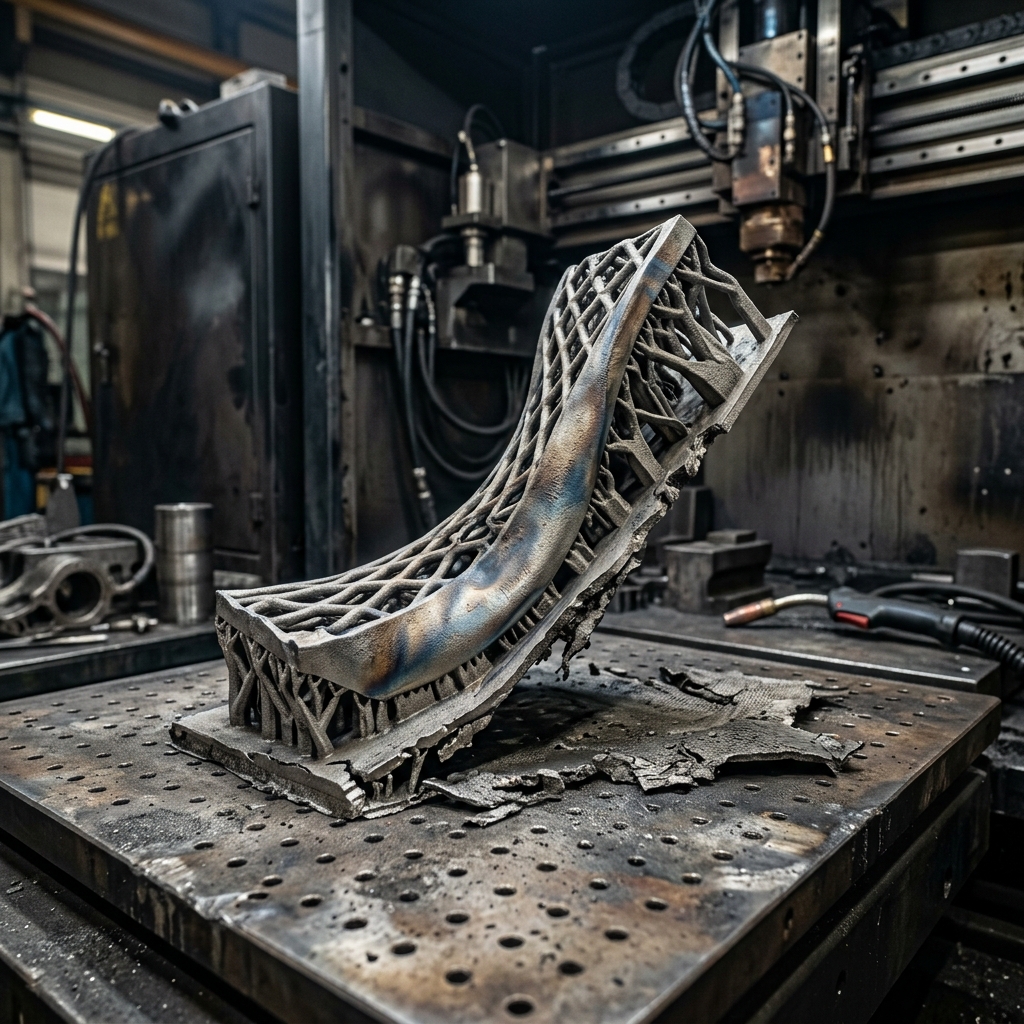
If these stresses exceed the yield strength of the material, thermal distortion (warping) occurs. In the worst-case scenario, the part tears off the build plate or the recoater crashes into curled-up part edges, leading to an immediate failure of the print job.
Strategies for Stress Reduction
- Preheating the Build Platform: Heating the build plate (e.g., to 200°C for aluminum or up to 800°C for titanium aluminides in EBM systems) drastically reduces the thermal gradient, mitigating the generation of stresses from the outset.
- Adapted Exposure Strategies (Scan Strategy): A "checkerboard" pattern or rotating stripe patterns distribute the heat input more evenly across the cross-section, preventing the accumulation of macroscopic stress fields.
- Massive Support Structures: Where heat is generated, it must be dissipated. Solid, block-like support structures not only conduct heat efficiently into the build plate but also mechanically anchor the part against warping.
- Stress Relief Annealing before Detachment: The golden rule in post-processing: the part must never be cut from the build plate before it has undergone a stress-relief heat treatment in a furnace alongside the build plate itself.
Only through the perfect interplay of thermal management during printing and the correct heat treatment afterward can high-precision, dimensionally accurate parts be realized.
No comments yet. Be the first to reply!